Capaz+IT: Creating Pathways to Education and Opportunity
The Community Foundation for a greater Richmond understands that educational attainment is a key predictor for future success. To ensure more students have access to these opportunities, we partner with organizations across our region that provide high-quality educational programs and initiatives supporting children, youth and their families. One of these organizations is Capaz+IT.
Capaz+IT is a local nonprofit dedicated to supporting the career growth and wellness of immigrant communities. Last year, the Community Foundation provided a Community Impact Grant to support Capaz+IT’s Newcomers Program, which offers immigrants and recent arrivals sixteen years or older with the support, resources, and preparation they need to earn their GED.
But long before Capaz+IT existed as an area nonprofit, it began as an interpreter training program housed within the Virginia Department of Behavioral Health and Developmental Services (DBHDS). According to Spencer Turner, the co-founder and assistant director of Capaz+IT, he didn’t foresee the interpreter training program being long-term.
It was only when Turner and Dilshad Charania met as a part of their work within DBHDS that the initial idea was born. Charania now serves as Capaz+IT's co-founder and executive director.
“We started talking about how we lived in the same area,” Turner remembers. “And how we had different connections within the immigrant community. I had worked in public schools, and she had worked in immigrant resettlement. We decided to come together to see if we could come up with a way to deliver these [interpreter] trainings ourselves.” 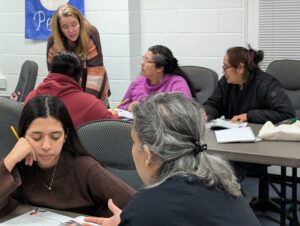
Turner and Charania identified digital skills as a fundamental gap within the immigrant community, as well as skill gaps that could make the interpreter training they planned to offer difficult to complete. As they learned more about the specific needs of the refugee and immigrant community, they also began preparing individuals for a wider variety of workforce opportunities beyond training to become an interpreter.
Captaz+IT got its start with initial financial support from CodeVA, as well as funding from Richmond Memorial Health Foundation (RMHF). Once they earned nonprofit status and sought to expand their support for individuals from refugee or immigrant communities seeking to earn their GED, they reached out to the Community Foundation.
“When they began expanding their programming, partnering with schools, and providing access to other career pathways outside of interpreting, it made sense for the Community Foundation to get involved,” remembered Leanne Petroziello, Community Foundation’s Officer for Educational Success. "What they're doing checks all the boxes. It's a proven idea run by people who are experienced and ingrained in the community already, doing it with them and not for them.”
With support from the Community Foundation, Capaz+IT was able to build out their Newcomers Program, offering ESL classes, digital skills classes, and academic support and literacy classes to students from across Richmond Region school divisions.
"We want to make sure our programs are meeting people where they are,” Turner said. “And we want to be sure we’re meeting the needs that people have.”
Part of that process has also been addressing very basic issues Turner and Charania have encountered, like figuring out how to teach students who haven’t spent time in a classroom in years.
“It’s difficult because many of the kids we work with have had interrupted formal education,” Turner said. “They don't know how to engage in a formal classroom setting because they were never able to develop those skills. And with so much stress outside of the classroom, it can be difficult to make school a priority.”
But now, with Ramsey Church providing Capaz+IT classroom space and new staff member Maria Romina Gutierrez Perez joining the team, Turner has seen trust, relationships, and community take shape.
Perez has been meeting with families, establishing connections with students to encourage them to come back to participate in Capaz+IT’s classes. She’s also working directly with attendees during the ESL classes to establish personalized goals. 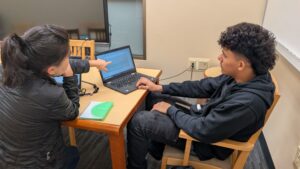
It’s this kind of community-centered, responsive work that Petroziello sees as essential.
"Capaz+IT is actively removing systemic barriers for a group that doesn't have the resources to overcome these hurdles by themselves,” she said. “Their team is providing skills with connections to a diploma, GED, a certification, or a job. It’s the kind of intensive barrier removal that these members of our community need."
Turner put it even more simply: “This is a place of hope.”